URWERK unveiled the UR-300 Time Quantum in Geneva on October 15, 2026, and it changes how the brand’s signature wandering hour behaves. Instead of satellites orbiting a carousel, two hour modules lock together in a T-shaped frame that, at the top of every hour, jumps forward, rotates, and rebuilds itself in an instant. It comes in two limited editions of 25 pieces each, one in titanium and one in titanium with an AlTiN treatment.
The URWERK UR-300 Time Quantum, unveiled October 15, 2026, replaces the brand's orbiting satellite hours with a T-shaped frame of hour modules that jumps and rebuilds itself every hour. It is limited to 25 pieces in titanium and 25 in AlTiN-treated titanium, at CHF 168,000 each before taxes.

For nearly three decades, URWERK has looked outward for ideas—to the natural world and to outer space—which is how satellite hours became the brand’s calling card. With the UR-300, co-founders Felix Baumgartner and Martin Frei turn the lens around. The watch opens a new collection built around what URWERK calls the final and most mysterious frontier of all: quantum mechanics, the invisible interactions of atoms and energy-charged particles that govern everything around us.
The mechanics change along with the theme. From 2005’s Opus V, made in collaboration with Harry Winston, to 2024’s UR-150 Scorpion, URWERK has often punctuated the hour with a retrograde snap back to zero. The UR-300 jumps forward instead. Earlier models choreographed swirling hour modules and skeletonized minute hands; this one relies on a single controlled burst of stored power that changes the state of the entire system at once.
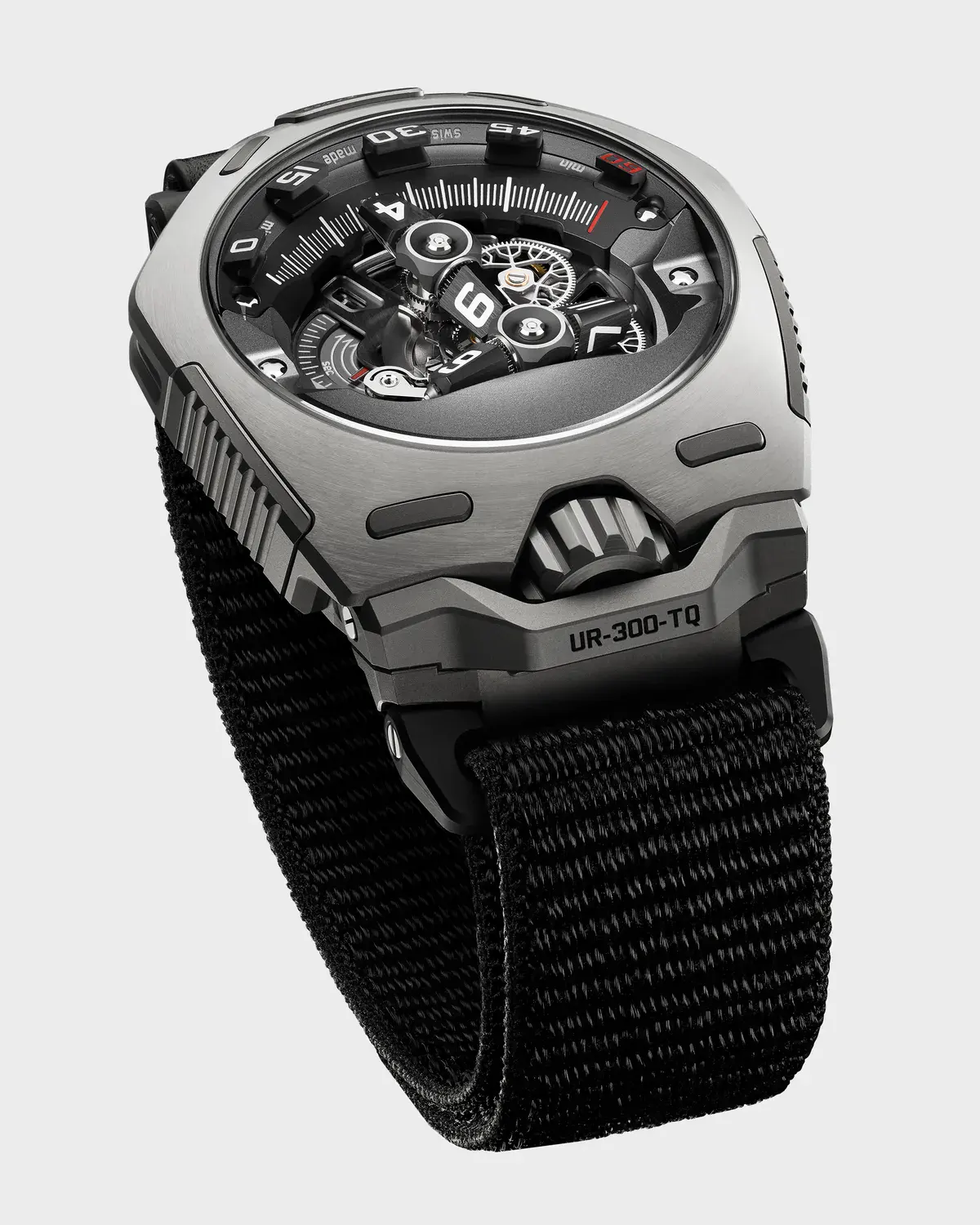
Felix Baumgartner, URWERK’s master watchmaker and co-founder, explains the thinking: “The world of the atom is fascinating because it exists in a state of constant, temporary equilibrium. Introduce energy into the system and its structure breaks down, reorganizes and shifts into a new state. That idea of transition is what I wanted to translate into mechanics with the UR-300. Beneath the sapphire crystal, you can watch a kind of ‘atomic’ reaction unfold in real time, as the elements move, interact and reconfigure before your eyes.”
It’s a lofty brief for a wristwatch. Happily, the mechanism more than lives up to it.
How the T-Frame Jumps
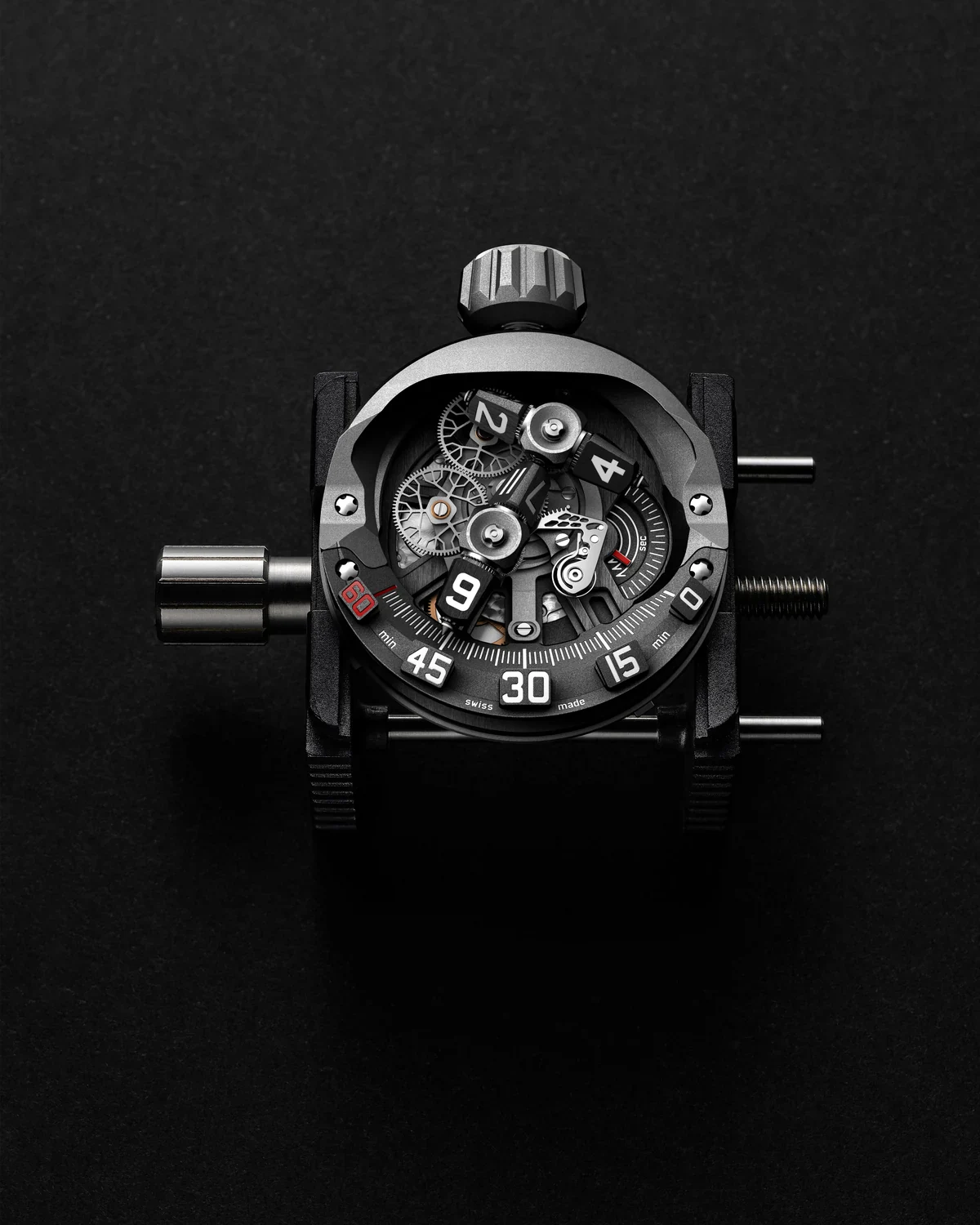
Two linear hour modules are fixed at right angles to form a T-frame—and yes, the T stands for Time. Each module is double-ended, with a three-sided hour prism at each end, so between them the four prisms carry all 12 hours. The prism at the base of the T shows the current hour as it travels along a 108-degree arc marked with the minutes from 0 to 60.
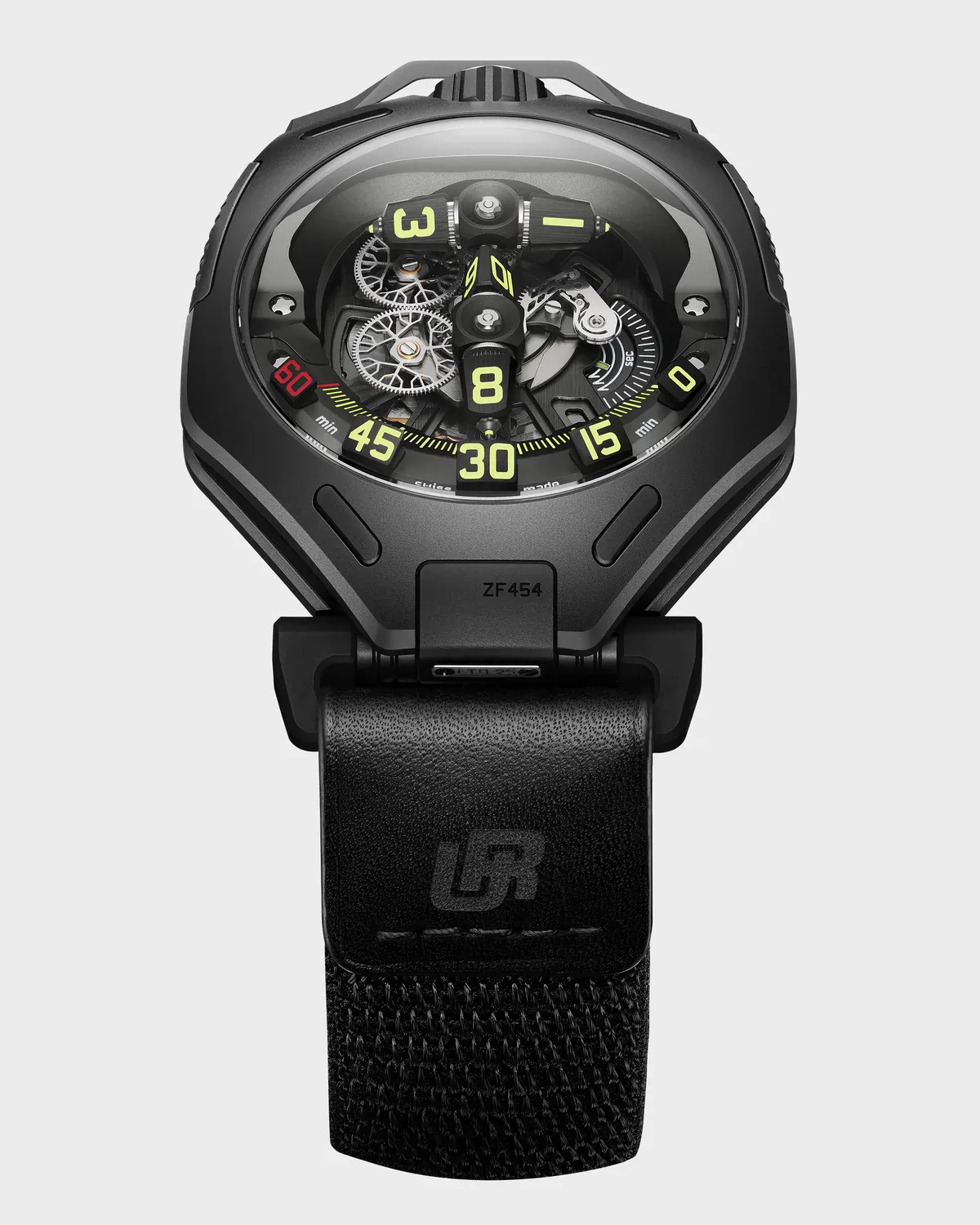
The moment the base of the T reaches the 60th minute, the whole display goes into motion at once. The T-frame jumps forward and rotates 72 degrees to bring the next prism into position. The old crossbar pivots around its midpoint to become the new stem, lining up with the zero-minute mark, while the old stem turns the opposite way to become the new crossbar. Meanwhile, every hour prism spins, so the one at the base of the new stem shows the next hour.
URWERK compares the two modules to quantum entanglement, in which two particles show linked behavior even when they are physically separated. Change one variable—in this case, time—and the whole system reconfigures and settles into a new equilibrium. In our view, that’s the most compelling part of the watch. Every 60 minutes, the display takes itself apart and builds itself back up, right there in plain sight under sapphire.
Martin Frei, URWERK’s artistic director and co-founder, sees the same subject at a different scale. “We have shifted scale, but from the infinitely large to the infinitely small, reality remains the same,” he says. “Every hour, the mechanism disassembles and reassembles itself in the blink of an eye, faster than our minds can follow. Suddenly, processing speed becomes another fascinating ingredient in our search to expand the experience of time. At that moment, the person wearing the watch becomes part of the event.”
Inside the UR-30.01V
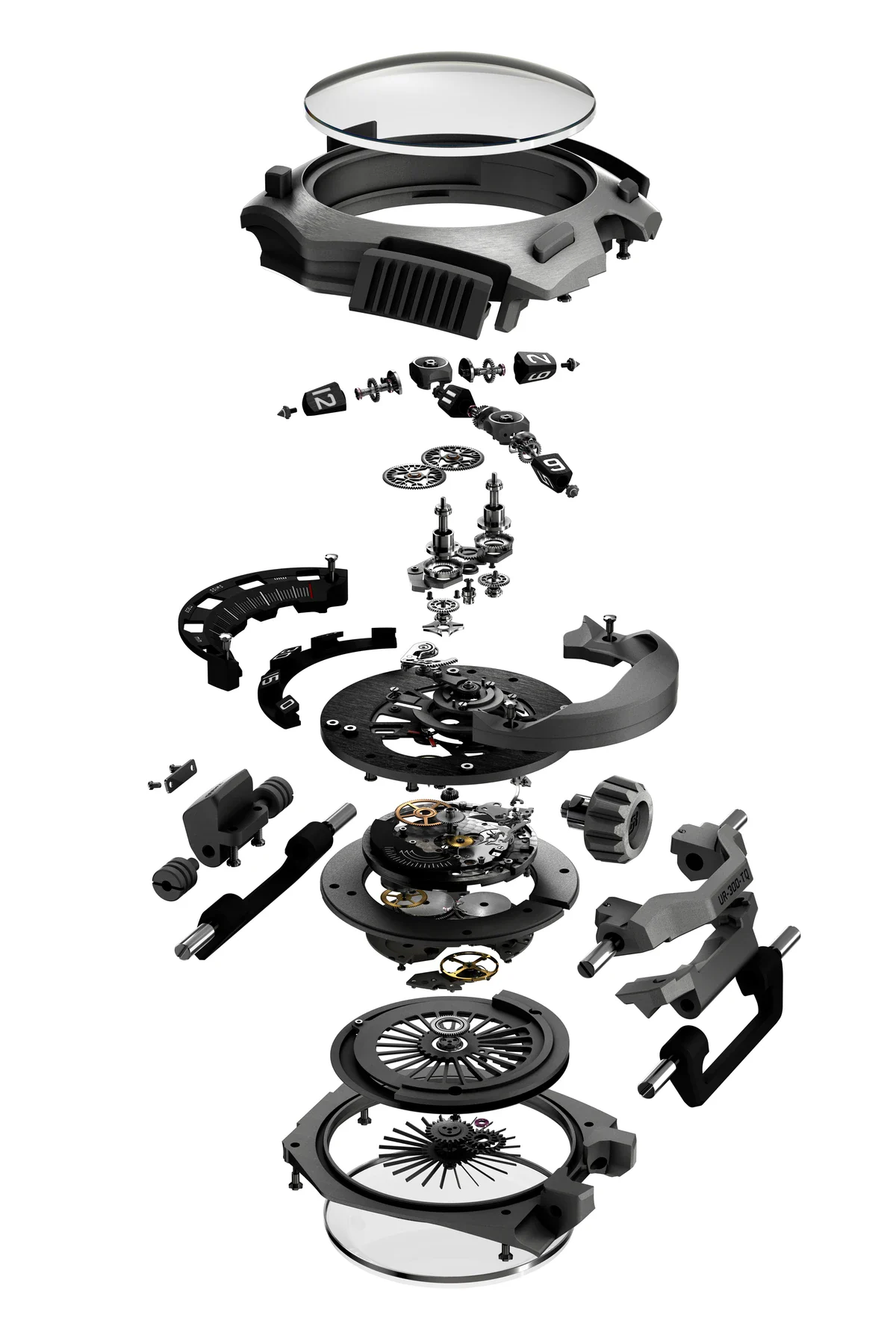
Making that jump work was the hard part. URWERK has built jumping and retrograde elements before, but never at this scale, and the brand clearly enjoys the irony that its watch about the smallest interactions is its most technically ambitious project. The jump needs enough energy to drive the whole sequence, but not so much that it causes visible recoil in the display or strains the movement unnecessarily. The tolerances also had to absorb a sudden acceleration every hour without letting the gear teeth engage too loosely.
The answer is the automatic Calibre UR-30.01V, its winding regulated by URWERK’s patented Dual Flow Turbines. The hour mechanism is a patent-pending modular planetary complication: its prograde hour modules ride on planetary gears, are controlled by a cam, rack, and spring, and are indexed by a Maltese cross. The modules themselves are beryllium copper, brass, and anodized aluminum, set on a baseplate of ARCAP AP1D and titanium, with LIGA-processed nickel parts.
To ease the load on the double mainspring barrel, URWERK kept the component count down, then added the safeguards any jumping mechanism needs so the time can still be set both forward and backward. The movement beats at 4 Hz on 40 jewels and delivers a 44-hour power reserve. Three hands handle the seconds, each covering 20 seconds across 120 degrees. The finishing runs from circular and straight graining and sanding to côtes de Genève and chamfered, polished screw heads.
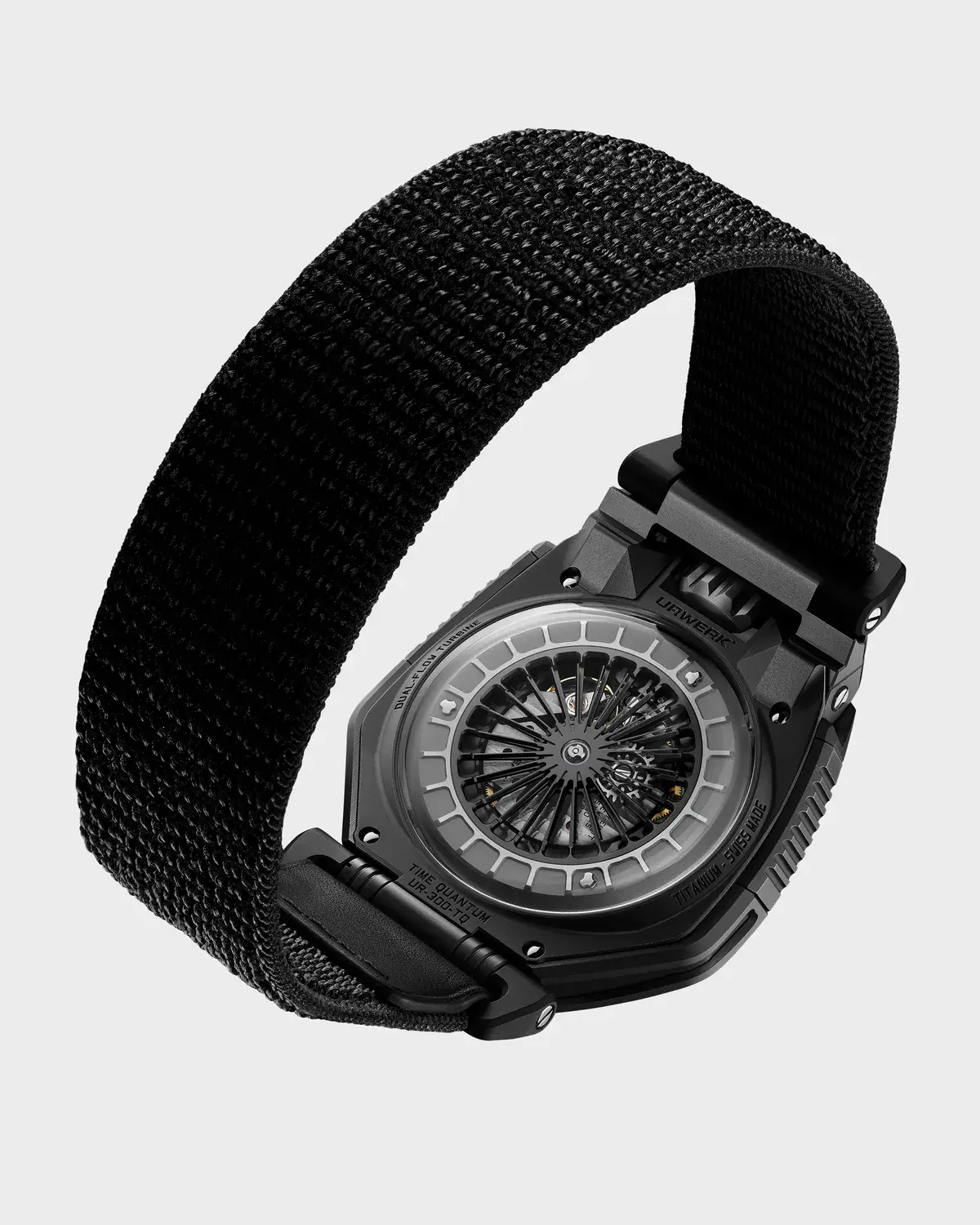
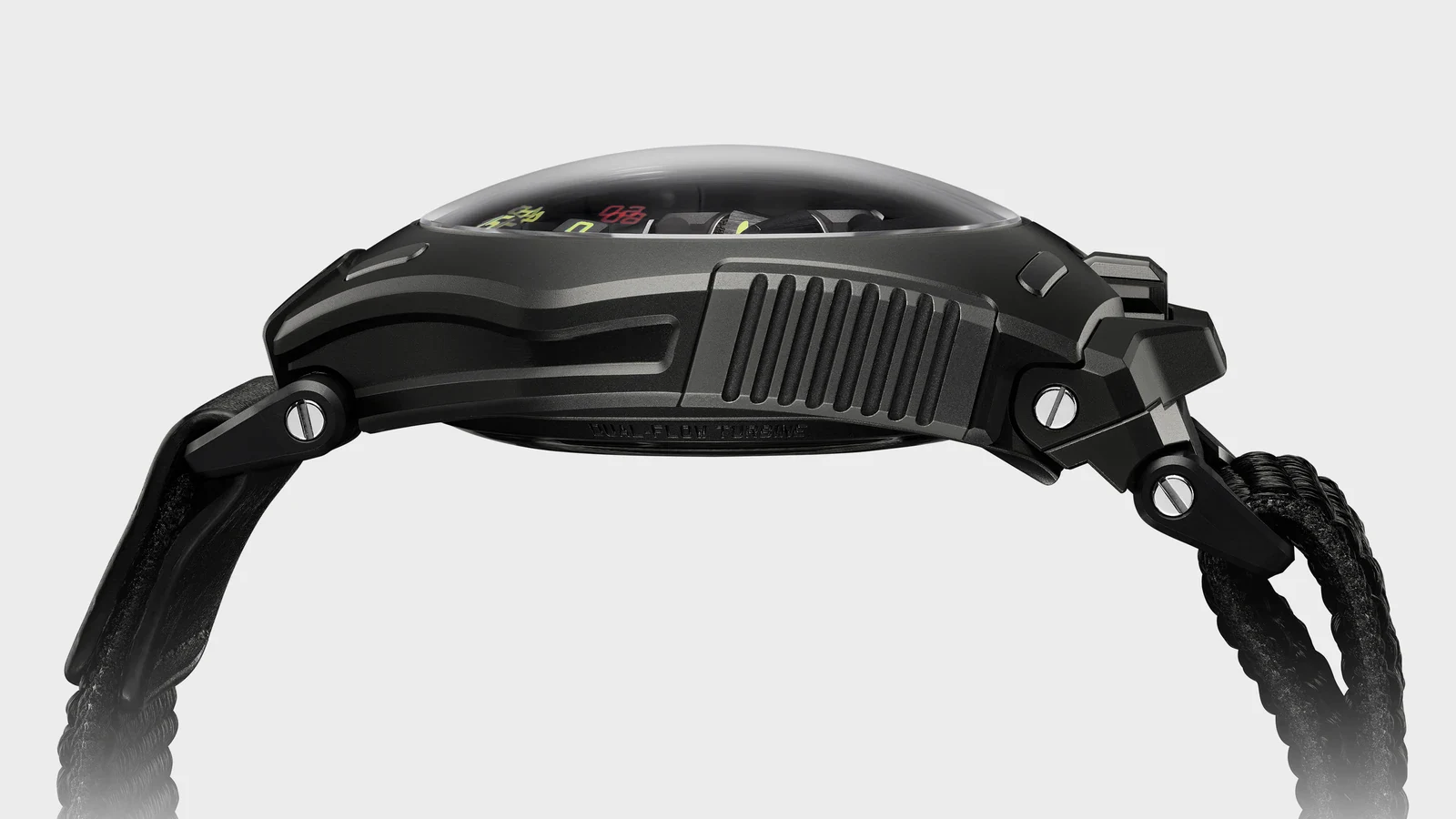
All of this sits in a case measuring 45.2mm by 58.8mm and 18.25mm thick, with anti-reflective sapphire crystals, water resistance tested to 3 ATM, and a NATO strap. The Titan model is Grade 5 titanium; the AlTiN model adds a PE-CVD treatment to the same Grade 5 titanium. It’s a big watch, and it makes no apologies for that.
Both versions are priced at CHF 168,000 before taxes. For a brand founded in 1997 that makes only around 200 watches a year, the UR-300 marks a new chapter, and a convincing one. The satellites have landed. At URWERK, the hour now arrives with a jump.
| Specification | Detail |
|---|---|
| Model | URWERK UR-300 Time Quantum (Titan and AlTiN) |
| Movement | Calibre UR-30.01V, automatic winding regulated by Dual Flow Turbines (URWERK patented) |
| Jewels | 40 |
| Escapement | Swiss lever escapement |
| Balance | Monometallic balance wheel, flat balance spring |
| Frequency | 4 Hz (28,800 vph) |
| Power source | Double mainspring barrel |
| Power reserve | 44 hours |
| Hour mechanism | Modular planetary complication (patent pending): prograde hour modules on planetary gears, controlled by cam, rack, and spring, indexed by a Maltese cross |
| Display | Revolving modules with prograde wandering hours; minutes on a 108-degree arc; three hands showing 3 x 20 seconds across 120 degrees |
| Movement materials | Hour modules in beryllium copper, brass, and anodized aluminum; baseplate in ARCAP AP1D and titanium; LIGA-processed nickel |
| Finishing | Circular and straight graining, sanding, côtes de Genève, chamfered and polished screw heads |
| Case | Grade 5 titanium (Titan, 25 pieces); Grade 5 titanium with PE-CVD treatment (AlTiN, 25 pieces) |
| Dimensions | 45.2mm x 58.8mm x 18.25mm |
| Crystals | Sapphire with anti-reflective coating |
| Water resistance | Tested to 3 ATM |
| Strap | NATO |
| Edition | 25 pieces in titanium, 25 pieces in AlTiN-treated titanium |
| Price | CHF 168,000 (before taxes) |
Timely FAQs
What is the URWERK UR-300 Time Quantum?
How does the URWERK UR-300 Time Quantum tell the time?
How is the UR-300 different from URWERK's satellite-hour watches?
What movement powers the URWERK UR-300 Time Quantum?
How big is the URWERK UR-300 Time Quantum?
What is the difference between the UR-300 Titan and AlTiN versions?
How many URWERK UR-300 Time Quantum watches will be made?
How much does the URWERK UR-300 Time Quantum cost?
