As the era of “hype watches” and conspicuous wristwear reaches a prolonged fever pitch, many collectors have begun gravitating toward something altogether quieter. Timepieces measuring 39mm and below have found renewed favor among enthusiasts who value nuance over notoriety. They are turning away from oversized cases and attention-seeking dials that announce their presence across a room, instead seeking out intricate hand-finishing and subtle gilding. These thoughtful details transform the act of checking the time into a gratifying excuse for admiring a masterpiece.
The Inimitable Angelus Monopusher Chronograph and Its New Italian Iteration
It is a shift that the Angelus Cronografo Telemetro Blu Ministeriale captures with remarkable confidence. While no shortage of contemporary brands have embraced the aesthetic codes of mid-century watchmaking, few can rival Angelus’ combination of authentic heritage, refined craftsmanship and industry-wide impact.
This latest release is more than just another handsome vintage-inspired chronograph. It is the newest chapter in one of watchmaking’s most fascinating revival stories. But first, let us welcome the belle of the ball.
The Angelus Cronografo Telemetro Blu Ministeriale
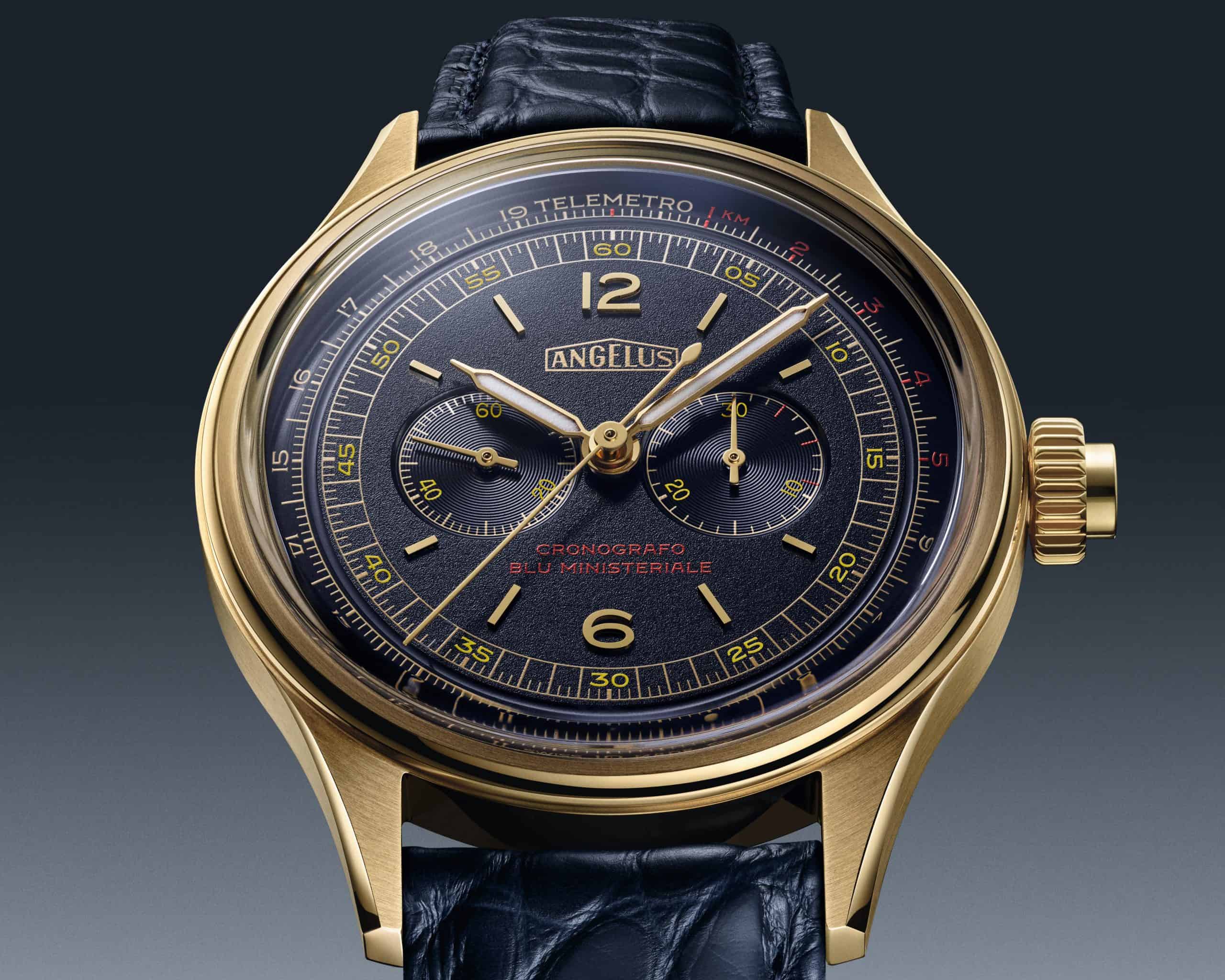
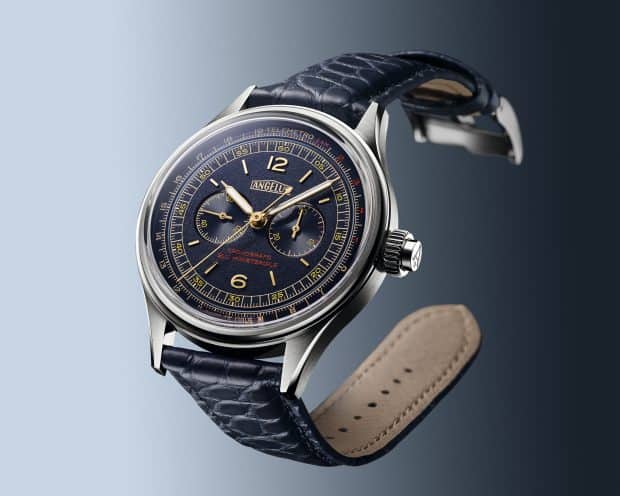
Measuring 37mm in diameter and powered by the same A5000 caliber found in recent Angelus chronographs, the Cronografo Telemetro Blu Ministeriale arrives dressed in the same regal shade of Italian blue worn by its national athletes. The watch features a small seconds display at 9 o’clock and a 30-minute chronograph counter at 3 o’clock.

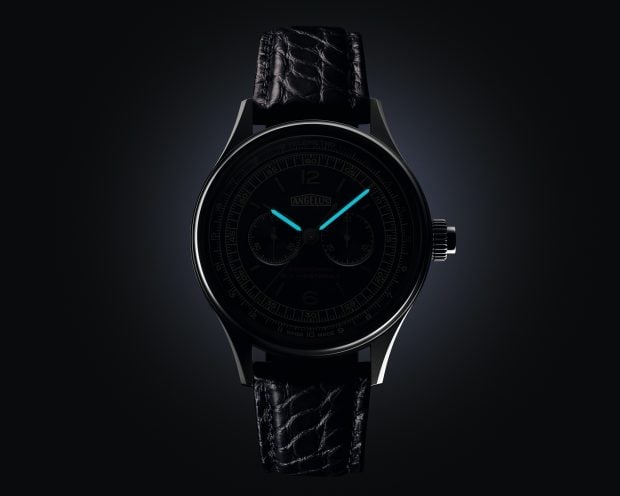
The concentric-patterned subdials contrast beautifully against a finely grained dial surface, itself framed by a satin-finished telemeter scale. Beneath a vintage-inspired domed sapphire crystal, red accents and yellow gold numerals lend warmth and character to a timepiece that measures a remarkably slender 9.25mm thick.
Just 10 examples in 18k yellow gold (€42,500) and 20 in stainless steel (€22,700) will be produced. The inscription “Uno di Dieci” (one of ten) or “Uno di Venti” (one of twenty) engraved on each caseback serves as a reminder of rarity. The watches will be available exclusively through four Italian retailers—Verga 1947 in Milan, Montres Bijoux in Genoa, Camparini Gioielli in Reggio Emilia and P. Bastiani in Trieste—all of whom played pivotal roles in the reinvigoration of Angelus.
The Angelus Reascends
Founded in 1891 by brothers Albert and Gustav Stolz in Le Locle, Angelus established a reputation for manufacturing reliable chronographs, alarm watches and minute repeaters entirely in-house.
At a time when many brands relied on outsourced ébauche movements and the collaborative établissage model of watch production, Angelus distinguished itself through its technical expertise. Its movements were respected enough to find their way into watches bearing the names of other manufacturers, including Panerai. Furthermore, the Angelus Chronodato of 1942 is widely recognized as the world’s first serially produced chronograph with a full calendar, and remains highly sought after by collectors today.
Like many historic manufactures, Angelus succumbed to the Quartz Crisis and disappeared in the late 1970s.
The brand remained dormant until its acquisition by movement specialist La Joux-Perret. Today, Angelus sits within the Citizen Watch Group alongside fellow haute horlogerie marque Arnold Son and movement manufacturer La Joux-Perret itself.
Yet, Angelus’s return was not an immediate success. The U10 Tourbillon Lumière, unveiled in 2015 as the reborn brand’s inaugural watch, divided collectors. Although nominated at the Grand Prix d’Horlogerie de Genève that same year, many enthusiasts felt its futuristic aesthetic bore little resemblance to the classical chronographs and Chronodato models that had made Angelus famous.
To its credit, the company listened. Under then-CEO Bertrand Savary, Angelus gradually refined its direction, culminating in the launch of the La Fabrique collection in 2023 and the return of elegant, classically proportioned watches such as the Chronographe Médical in 2023, and Instrument de Vitesse in 2024.
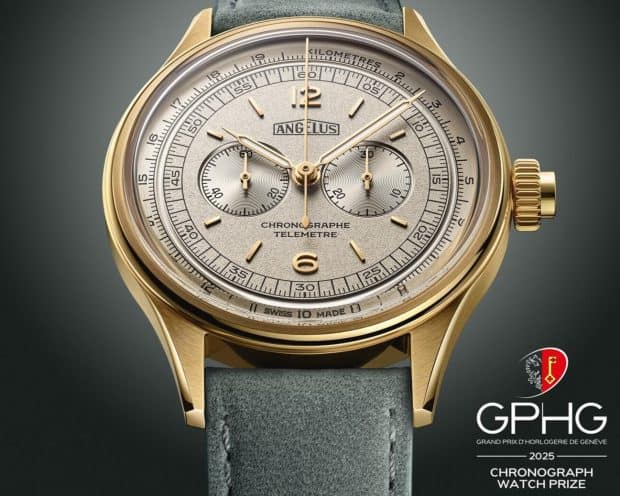
One could argue that the restoration of the Angelus name reached its culmination in 2025, when the yellow gold Chronographe Télémètre captured the GPHG Chronograph Watch Prize.
Under the stewardship of current CEO Pascal Béchu, Angelus will continue to create vintage-inspired chronographs powered by the caliber A5000—an innovative movement that involved some of today’s sharpest watchmaking minds.

The Flagship A5000
The monopusher chronograph represents one of the most important milestones in the evolution of sports timing. In an era when chronographs often required multiple actuators, it allowed the wearer to start, stop and reset elapsed time using a single button.
Today, Angelus’s monopusher chronograph has once again become its signature complication. The manually wound A5000 caliber measures a mere 4.2mm thick despite incorporating a column wheel, horizontal clutch and 42-hour power reserve.
Equally intriguing is the movement’s lineage. The A5000 traces its roots to the celebrated THA chronograph project associated with three titans of independent watchmaking: François-Paul Journe, Denis Flageollet and Vianney Halter.
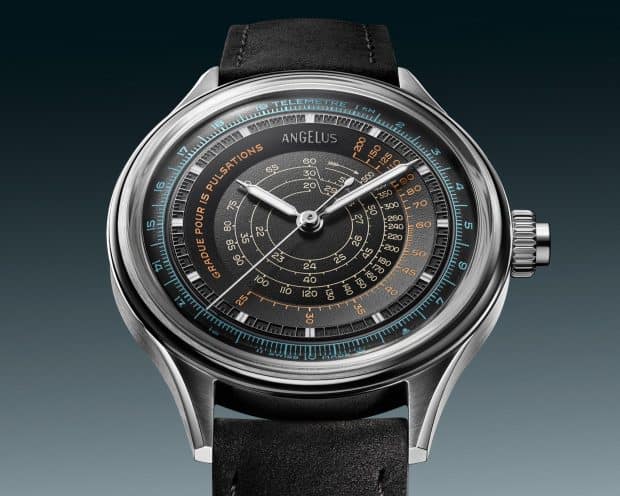
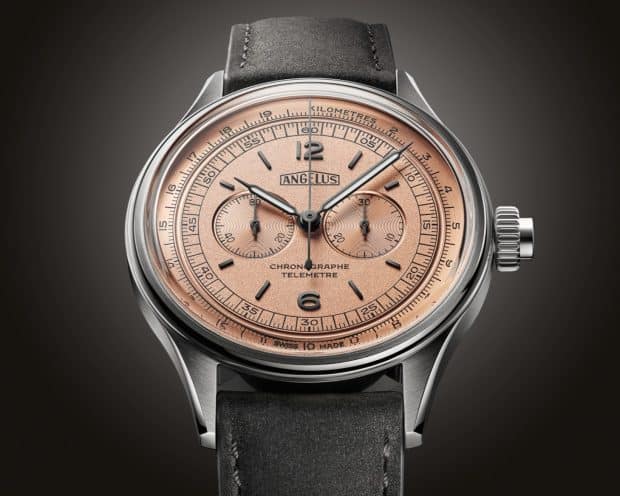
If the Cronografo Telemetro Blu Ministeriale is your cup of tea, check out the Instrument de Mesures, which is a 39mm steel limited edition that Angelus launched last week in two colorways. Descended from the Instrument de Vitesse, the Instrument de Mesures is also powered by the A5000, but combines a pulsometer, tachymeter and telemeter.
And if you like innovative chronograph timepieces, you might also enjoy the Montblanc 1858 The Unveiled Timekeeper Minerva, whose chronograph is activated by its fluted bezel; the Audemars Piguet RD#5, whose shallow actuators require minimal force; and the recent Parmigiani Fleurier PF Chronograph Mysterieux, which keeps its chronograph hand hidden until the chronograph is engaged.
